Saturday, May 10, 2008

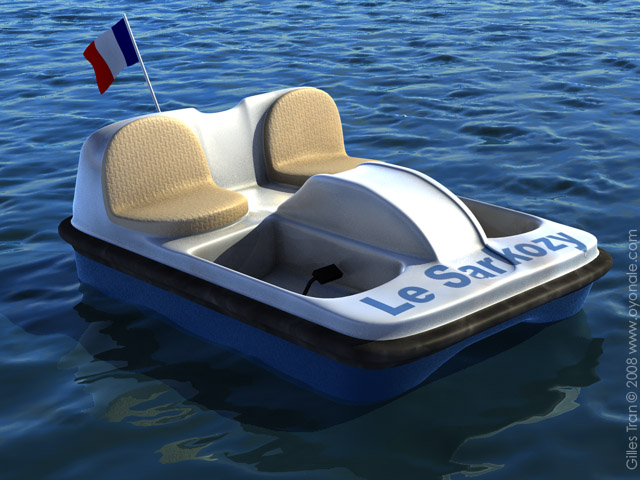
A silly image


A quick (45 minutes for the model, another 45 minutes for the environment, everything done in Cinema 4D) silly image to celebrate the future of the French Navy, given the current indecision relative to the construction of a second aircraft carrier. Not that I care, really, but I liked the idea of a pedal boat named after the diminutive Sarkozy (thanks to Marc Jacquier for the inspiration).

Labels: ,

Thursday, May 8, 2008

Organic art

1stAveMachine is a New York based computer graphics studio that specialises in photorealistic organic animations like these:


Wonderful stuff, but somehow it's something of a pity that such wild imagination has to be tamed and restrained by what ultimately foots the bill, in this case advertising.

Labels:

Wednesday, May 7, 2008

Office animations

A couple of years ago, we decided to reorganise our office space. Since it involved moving large pieces of furniture (including 3 libraries full of books and archives), I proposed to make a simulation first, to optimise the reorganisation. Finally we didn't change anything - it would have taken a good week - but I did a couple of animations with Cinema 4D and Advanced Renderer. Neither the models, texturing and the lighting are very elaborate: the models are just textured cubes (plus an iMac model I found on the French Cinema 4D website, even though we don't have Macs) and there's a lot of flickering due to the low radiosity parameters.

I planned to redo them with finalRender but this takes a lot of time and frankly it's not worth it. In any case, these videos were gathering dust on my hard disc, so they may as well be published here.

The first video is a time-lapse animation of the office from sunrise to sunset. You can see the time flying in the little corner in the bottom right corner. I used C4D's sky plugin to get the "true" light and sky colours from the lat/long coordinates of my office.


The second video is a fly-over of the office, as experienced by a (very sober) fly. It was just fun to do and wish I had the time to make it more realistic and detailed.

Labels:

Sunday, April 27, 2008

Handmade 3D

The Freres Hueon (apparently a couple of brothers from Bordeaux, France, but little information is available about them) made a "sweded" remake of the light cycle race in Tron, using cardboard props instead of computer graphics. As a Tron fan, I find this mightily impressive.


I should have a special altar built for Tron, as it is the original source of my deep love for computer graphics. I saw it in 1982 and found it so extraordinary and visually groundbreaking at that time that I sat through two consecutive showings. As we know, Tron was a commercial failure, and CG didn't really made it in the movies until Jurassic Park, 11 years later.

Still, Tron remains interesting in the way the authors took advantage of the limitations of the available technology. More recent movies overestimate the ability of 3D technology, so visual effects that look fantastic when the movie is released look fake and awkward after a few years (if not a few days), with characters deep into the uncanny valley and flat lighting. Tron has some cheesy parts (it was a mainstream Disney movie made in the 80s after all), but the effects, simple as they are, are still very pretty.

The Tron DVD also contains the following tidbit: as 3D was still largely experimental, the companies hired to create the computer graphics used very different technologies. Basically, one used polygons (for the Solar Sailer for instance) while the other used primitives (notably for the Light Cycles). The latter technology gave better, shinier results but with a price: in the DVD, we can hear Syd Mead, the designer hired to create the Cycles, lament the fact that his original smooth, curvy, organic-looking design had to be dumbed down into a bunch of spheres and cylinders... It is amusing that this debate still exists today in the POV-Ray community, where some users make a point of using only script and primitives while others have embraced polygon modelers.

Labels:

Tuesday, April 1, 2008

Welcome to my lonely Chinese visitor

I've subscribed to Google Analytics for some time now, and until yesterday, the visitors map for Oyonale looked like this.
Where have the chinese gone?
133 countries (light and dark green on the map) have sent visitors so far. In one month, there were 20 people from Saudi Arabia, 1 from Iraq, 1 from Afghanistan, 134 from Hungary and 9267 from the USA (hello to all of you, dear visitors). So who's missing? Turkmenistan, Burman, Yemen, Oman, Mali, Niger, Chad, Nigeria (which is strange, with all the dead billionaires' wives hailing from Lagos) and a few other African countries. And China. 1.3 billion chinese people can't see my images or read my silly stories. Only people from Hong Kong are free to do so, thanks perhaps to the "one country, two systems" policy. You can verify this using Websitepulse, a site that tests an URL from Shanghai, Beijing or Hong Kong.
Not that the Chinese government really objects to Oyonale. The Great Firewall of China actually blocks my host's entire IP range. I have other sites hosted by the same ISP that are also invisible to Chinese internet users. It's impossible to know the cause for the ban, of course. Perhaps the Chinese government will relax the Firewall for the Olympics, I don't know.

And yesterday, someone from Beijing broke through the Firewall, my first Chinese visitor. That person visited one page and spent 0 second reading it, so I fear this wasn't a real person. In fact it was probably a bot. Websitepulse still reports that Oyonale is blocked in Beijing and Shanghai. But, whoever you are, Chinese visitor, I salute you.

Labels:

Thursday, March 27, 2008

Reach for the stars: the story that never was

Reach for the stars
In 2002, I was invited by Chris Cason, the leader of the POV-Ray development team, to work on a very special project: the creation of a computer-generated image that would be rendered on board of the International Space Station. With fellow POV-Ray artist Jaime Vives Piqueres, we designed the image according to a drastic set of specifications, then the image script and 3D models were sent to internet entrepreneur and astronaut Mark Shuttleworth (who would create the Ubuntu Linux distribution two years later) who loaded it on a laptop, turned it into a big-size image while floating in zero-gravity, and came back to Earth. The entire story is told here and there's not much more to say about the image itself.

The strangest thing, however, is that we completely failed to make that story interesting to other people. We naively believed that the concept of two (unknown) geeks managing to smuggle artwork on the ISS thanks to a "space tourist" was, if not newsworthy, at least cool enough for people to notice it, particularly in the computer graphics and open source communities. The simple fact that Chris Cason had to modify POV-Ray to accommodate zero-gravity was an interesting tidbit: how many popular software, let alone open source popular software, include special code to go to space. And of course this image remains the first one rendered in orbit.

Some folks did like the story: Zazzle, the poster company, created a special page for it. There's a page about the image in the Polish Wikipedia and once in a while a teacher wants to use the image for a school project. But otherwise, the story was lost in the flow. We submitted it several times to Slashdot, the popular "news for nerds" website that caters to open source enthusiasts, to no avail. DAZ, the company that had created the child model used in the picture, turned us down because they believed that our story was critical of the model (it wasn't). I posted it to a forum dedicated to space flight and astronomy news: no answer. I wrote to people who had a special interest in space-related artwork: no answer. Outside the POV-Ray community, where a few people at least reacted to it, the story fell completely flat and wasn't picked up: it made a brief appearance in a French CG website, and, some years later, it resurfaced in a couple of posts in the Ubuntu forums when people discovered it in Mark Shuttleworth's resume, but by far and large our story was ignored by bloggers and on-line forums.

Now there are many reasons for the failure. The timing was terrible because we couldn't use the short window that was the space flight itself: the laptop with the image on it came back months later, once the flight was completely forgotten. Also, we didn't really push the story: we thought that it had legs, that it would run by itself and sort of snowball once released in the internet but, unlike the most braindead LOLCAT, it didn't. We could have spammed every open source, computer graphics, art or aerospace forum out there, but we had obvious ethical reasons for not doing so and forum users don't like being spammed in any case. Another reason is that space flights are no longer newsworthy: people don't care much about the space shuttle, the ISS or astronauts unless they end up in big fireballs. Another is that the whole concept of "rendering" a 3D image is lost on the immense majority of people who, rightfully, couldn't understand what had been done in the first place.

I don't have any regret of course. Mark got home safely, and while the image isn't the best computer rendering ever, we had fun doing it, it was an exciting project and it's still a good story to tell. It's just that we would have liked to share it with more people.

Labels:

Saturday, March 22, 2008

Hacking a cheap Canon camera

My cheap Canon IXUS 950 (Powershot SD800 IS in other countries) is a good little camera. Sure, I'd prefer a serious SLR with better lenses and more sophisticated light metering, but digicam quality is good enough for what I do, i.e. mostly family pictures and tourist shots. It's also extremely light (150g!) which makes it ideal to carry around in my pocket, unlike a SLR weighing one kilo and more. However, the manual controls are extremely limited: ISO, exposure, white balance, image size and some (largely useless) color tweaking. There's no way to override autofocus, shutter speed or aperture. Also, there's no battery gauge except the one that starts flashing 2 minutes or so before the battery is finished, which is completely stupid... except for Canon, who probably sells more backup batteries that way.

Now it turns that some very clever folks have developed a firmware enhancement called CHDK (Wiki pages and download area) (I guess it stands for Canon Hack Development Kit) that adds interesting features to several cheap Canon digicams, including RAW file support, battery indicator, ISO control, shutter speed control, focus control (didn't work for me though), histogram (RGB/luminance), zebra mode (areas of over-/underexposure), DOF calculator, scripts (in BASIC!), focus bracketing, exposure bracketing and more. Exposure bracketing is particularly interesting for creating high-dynamic range images, both as 8-bit images for display (see image below) or 32-bit true HDR images for use as environment textures in 3D computer graphics.

HDR image created with exposure bracketingThe CHDK wiki describes the firmware in detail and provide links to download pages and utilities (like RAW conversion and processing software). Installation is simple, just copy a couple of files in the root directory of the SD card and load the firmware according to the instructions. The firmware is not stored in the camera itself, so it's always possible to revert to the original firmware. Whether using CHKD voids the warranty isn't clear from a legal point of view, but then wiping the SD card should work ;)

This kind of hack is also a clear demonstration that these cameras are actually crippled for pure marketing reasons. There's absolutely no technical rationale for selling them without a proper battery indicator and the ability to override automatic settings. These practices are common for software, but it's a little unsettling to see them in hardware too.

Labels: